Data centers and customer protection
As communities grow and technology evolves, we are seeing increasing interest from data centers and other large energy users looking to locate in our region. Black Hills Energy supports responsible growth and economic development, and we are committed to serving customers across our service territory. At the same time, we have a responsibility to ensure that growth is managed in a way that maintains safe, reliable service and delivers value for existing customers. Our priority remains unchanged: providing dependable energy service to the homes, businesses, schools, hospitals and emergency services that rely on us every day. We welcome new opportunities, but we believe they must be developed thoughtfully and in a manner that benefits both new and existing customers.
Powering growth. Protecting our community.
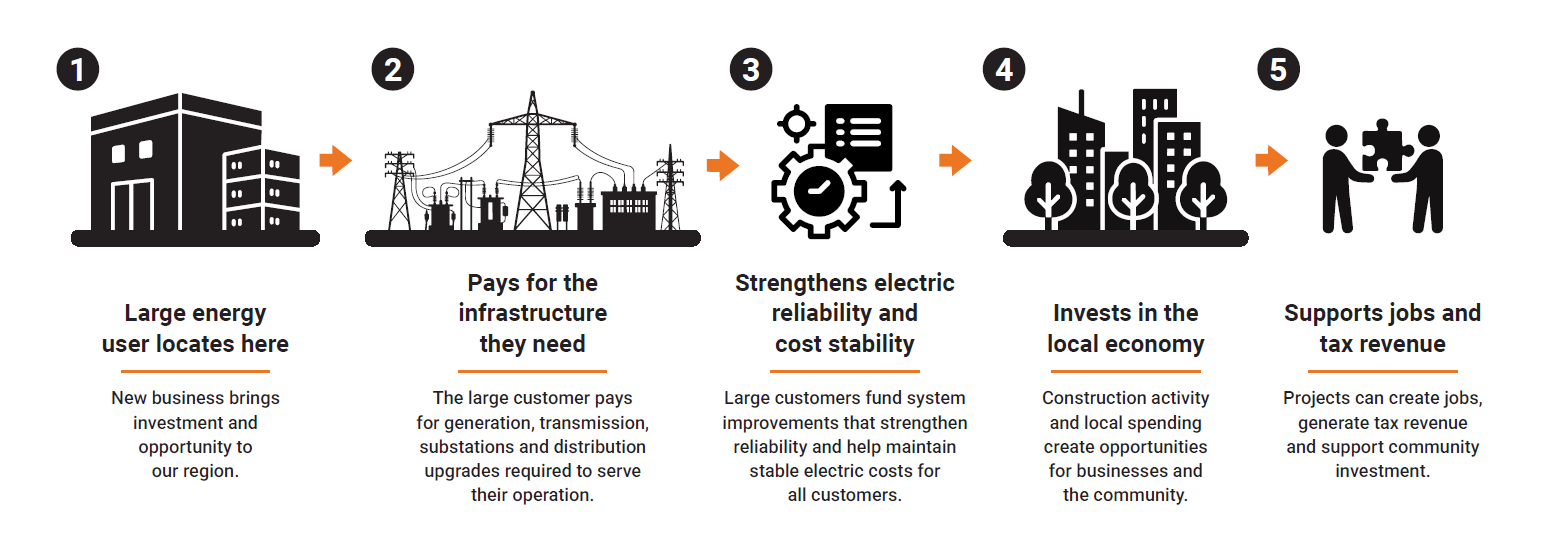
As a regulated public utility, Black Hills Energy has an obligation to serve all customers seeking electricity and/or natural gas service in our defined service territory. As data centers and large customers seek service, we carefully evaluate new service requests to understand energy load requirements and system impacts. This approach ensures new generation and system upgrades support reliability, resilience, and affordability for all customers.
We have had a Large Power Contract Service tariff (LPCS), in place for 10+ years. This innovative framework supports economic growth and investment in the region, while providing cost protections for other retail and industrial customers. Under the LPCS tariff, data centers pay their own way for the energy they need to power their operations and for the use of our electric grid. Infrastructure upgrades in generation, transmission, and distribution are paid for by the data center or large use customer as required by the tariff.
How Black Hills Energy evaluates large energy users
Large energy users can require significant planning and infrastructure. Before moving forward, projects may be evaluated based on factors such as:
- Electric demand
- Available system capacity
- Infrastructure requirements
- Reliability needs
- Cost responsibility
- Local permitting and zoning requirements
- Community impacts and benefits
- Regulatory requirements, when applicable
Depending on the project, review may also involve local governments, permitting agencies and regulatory bodies. Every project is evaluated based on local conditions and community needs.
What is a data center?
A data center is a building that houses computer servers and related equipment used to store, process and transmit digital information. Data centers support services people use every day, including cloud storage, online banking, video calls, streaming services, business software and artificial intelligence applications.
Data centers vary significantly in size and purpose. Some serve global technology companies, while others are smaller regional facilities that support local businesses and organizations.
Data centers and blockchain are not the same
Data centers and blockchain operations are sometimes discussed together, but they often have different operating characteristics and energy needs.
Traditional data centers generally require continuous, highly reliable electric service. Some blockchain operations may be able to reduce or interrupt energy use under certain conditions. Because of these differences, service structures that may be appropriate for one type of customer are not necessarily appropriate for another.
In Wyoming, we have had a Blockchain Interruptible Service Tariff in place since 2018. This innovative solution is designed to meet the unique energy demands of blockchain operations without adding costs to existing customers.
Regulatory oversight and customer protection
Regulatory oversight plays an important role in customer protection. Depending on the service structure or project requirements, proposals may be subject to review by regulatory agencies and other governmental entities.
This review process helps to make sure that customer interests, reliability considerations and cost protections are appropriately evaluated. In addition to regulatory review, some projects may require local permitting, zoning approvals and infrastructure planning before moving forward.
Responsible growth can benefit communities
When planned responsibly, large energy users can contribute to economic development through construction activity, long-term employment opportunities, local investment and tax revenue.
At the same time, growth should be carefully evaluated to make sure it’s the right fit for the community and does not come at the expense of existing customers. Black Hills Energy's role is to help communities grow while continuing to provide safe, reliable energy service.
Our commitment
For more than 140 years, Black Hills Energy has been committed to serving the energy needs of our communities. As interest from new businesses and large energy users grows, we remain dedicated to providing safe, reliable service to all customers across our service territory. We support responsible growth that creates opportunities for communities, while helping maintain affordability, reliability, and long-term benefits for the customers who depend on us every day.
Frequently asked questions
Will data centers increase my electric bill?
No. Black Hills Energy works to protect existing customers by making sure large energy users are responsible for the infrastructure and energy needed to serve their operations. Service structures, regulatory review and local planning processes help support customer protections.
Who pays for infrastructure needed to serve a data center?
Wyoming laws and tariffs exist to prevent large loads from shifting costs to other customers. As a result, the data centers in our service territory pay for all new infrastructure necessary to serve them and pay for their use of the shared electric grid, reducing total costs to other customers.
How does Black Hills Energy protect customers from costs associated with large energy users?
Large load development must be evaluated under a disciplined framework that protects existing customers, maintains reliability, and requires the large customer to pay its way. Our Large Power Contract Service Tariff has been in place in Wyoming for over a decade and requires large load customers and data centers to pay their full share of the infrastructure costs needed to serve them.
Will data centers affect electric reliability?
Maintaining reliable service for existing customers is a primary consideration when evaluating large energy users. Reliability needs, available capacity and infrastructure requirements are reviewed as part of the evaluation process. With our Large Power Contract Service Tariff, data center customers are required to pay their full share of the infrastructure costs to serve them. These significant investments and upgrades benefit all customers through improved reliability of our local system in Cheyenne.
Are data centers and blockchain operations the same?
No. While both may use significant amounts of electricity, they can have different operating characteristics and energy requirements. Traditional data centers generally require continuous service, while some blockchain operations may be able to reduce or interrupt usage under certain conditions.
Can service to large energy users be interrupted?
Some service structures may allow interruption under specific conditions. For example, service under Black Hills Energy's Blockchain Interruptible Service Tariff can be interrupted during periods of peak demand so existing customers remain the priority.
Is Lange II being built for data centers or blockchain businesses?
No. Lange II is being built to replace capacity that will be lost when the aging Ben French generation units retire. The facility is intended to serve existing customers and support system reliability and resilience.
Is Black Hills Energy's current rate review related to data centers or blockchain businesses?
No. The current rate review seeks recovery of investments made to support the safety and reliability of the electric system.
Do data centers use a lot of water?
Water use varies by facility design, cooling technology and operating requirements. Some facilities use advanced or closed-loop cooling systems designed to minimize water consumption.