Understanding your bill | Iowa
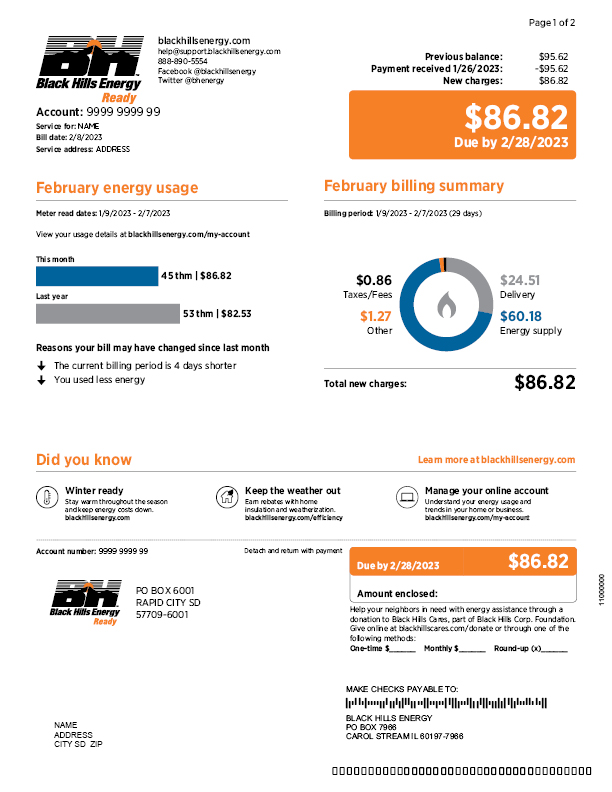
Your monthly bill makes it easy for you to identify key information, understand your energy costs and monitor your usage. The front of the statement provides a summary of your usage and charges in an easy-to-understand format. On the back page, you’ll find specific details about your bill.
Your bill breakdown
Use the dropdown to see additional information about specific charges. Depending on the type of service you receive, your monthly bill details may look different than the example shown below.
Bill overview
Key information
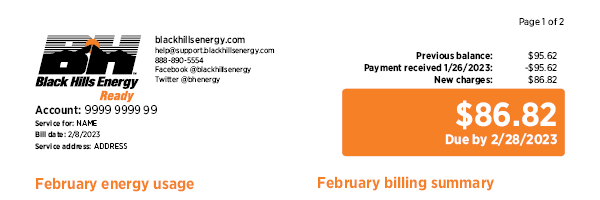
Your due date and the amount due are located at the top of the front page, along with your account number and service address.
Energy usage
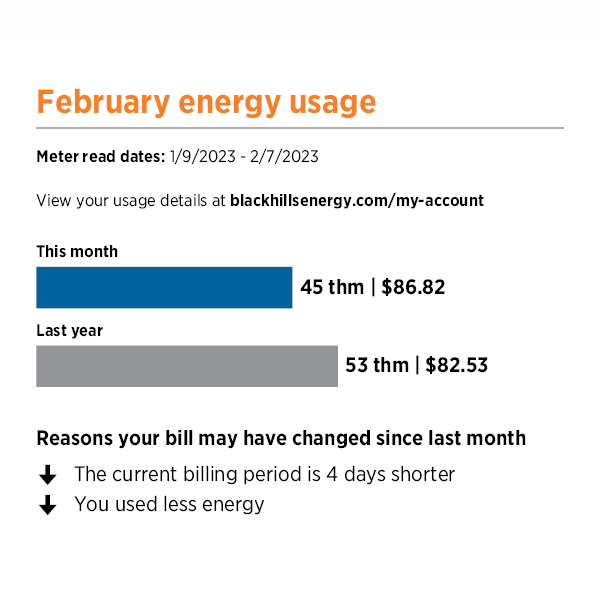
Easily compare this month’s usage to the same time last year and view reasons why your bill may have changed since last month.
Billing summary
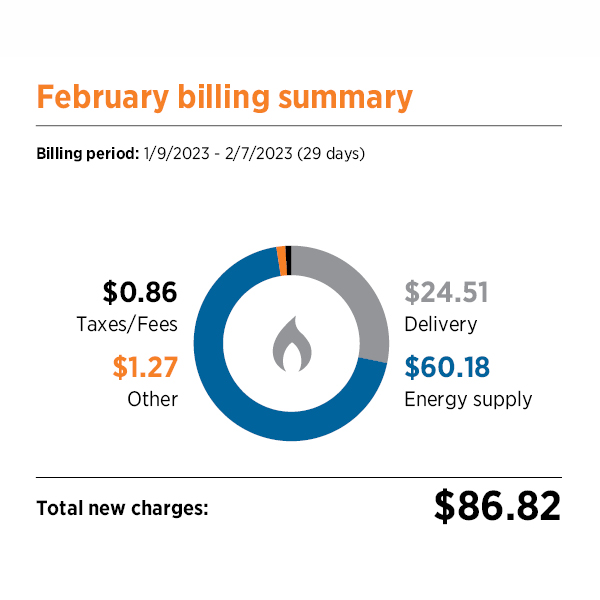
The billing summary breaks down your charges into four categories that are displayed in a simple, easy-to-read chart.
- Delivery: Costs to bring energy to your address. This includes the customer fee, which helps to cover the costs of pipelines, technology and equipment required to deliver that service.
- Energy supply: Pass-through market cost of natural gas.
- Taxes: Local and state taxes and fees.
- Other: Credits, adjustments and other charges included in your bill.
Did you know

In this section you’ll find useful safety information and specific tips to help you save energy and money.
Payment remittance
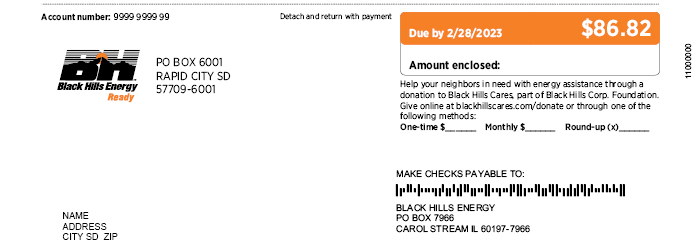
If paying your bill by mail, detach the bottom of the front page and include this with your check in an envelope.
Usage history
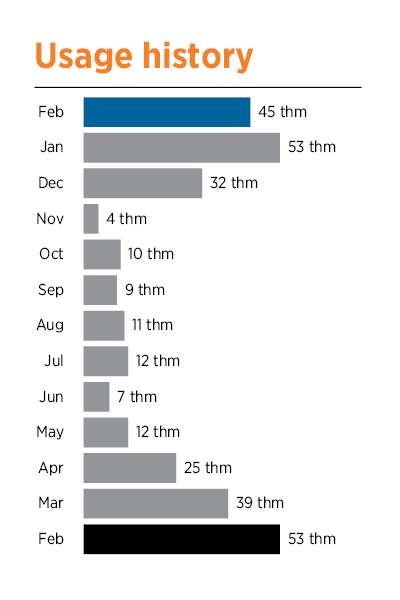
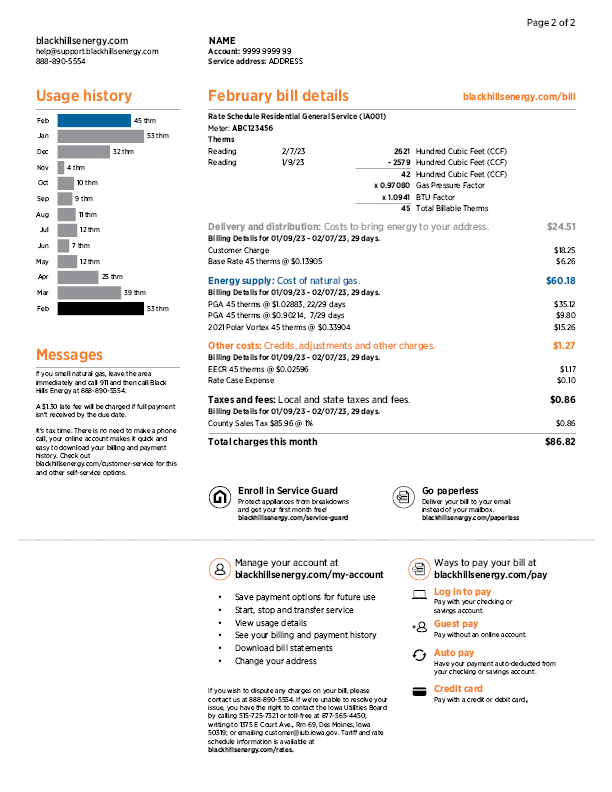
The last 12 months of usage history is available to help you see how this varies throughout the year.
Bill details
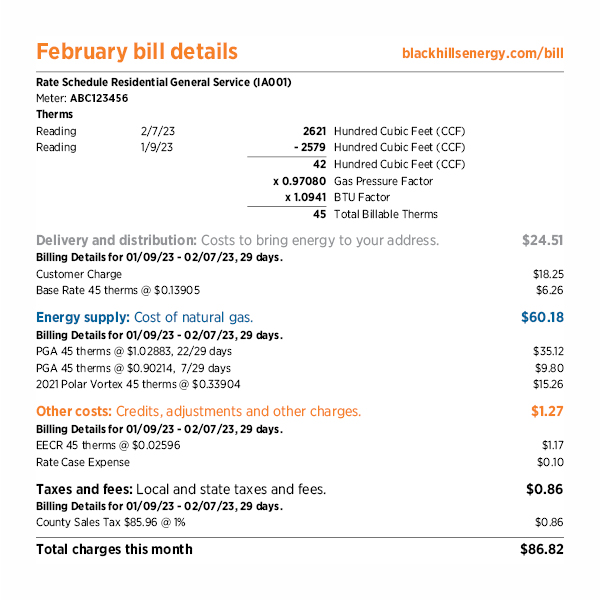
Specifics about your monthly charges are shown by category and color-coded to match the monthly bill summary chart on the front page.
Messages

Important information about your account is included in the messages section.
Your account
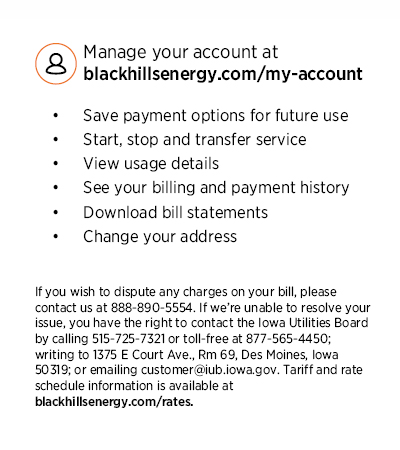
Managing your account online provides easy access to resources and tools, including:
- Viewing your usage and bill history.
- Starting, stopping or transferring service.
- Paying your bill or changing your payment method.
- Managing email and text alerts.
- Enrolling in programs such as Auto Pay and paperless billing.
Ways to pay
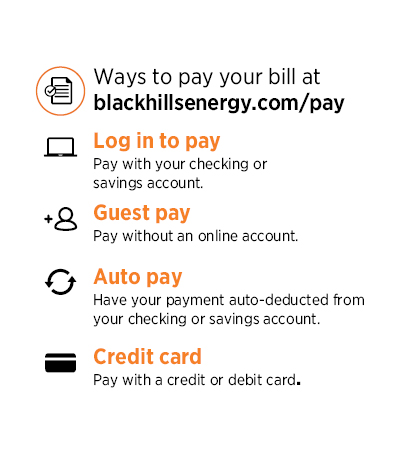
We offer several ways to pay your bill so that you can pick the one that’s right for you.
Explanation of Iowa Gas charges
Customer Charge: A fixed monthly charge, separate from energy usage, that recovers a portion of fixed operating costs, like customer services and customer-related facilities such as meters and service lines.
Base rate: A per-unit charge that recovers the costs of constructing, operating and maintaining the infrastructure necessary to transport, measure and deliver gas from supplier pipelines to the customer's premises.
Energy Efficiency Cost Recovery (EECR): A per-unit charge to recover the costs of Black Hills Energy’s energy efficiency programs, as required by state law and approved by the Iowa Utilities Commission (IUC).
Purchased Gas Adjustment (PGA): A per-unit charge to recover the estimated cost Black Hills Energy pays for natural gas that’s delivered to customers. Black Hills Energy purchases this natural gas on customers’ behalf. Given the volatility of the natural gas market, this charge is adjusted on a monthly basis and subject to an ongoing reconciliation process administered by the IUC. Black Hills Energy does not profit from the cost of gas; costs incurred by Black Hills Energy are recovered dollar-for-dollar from customers.
Rate Case Expense (RCE): A 36-month fixed surcharge established as part of the 2024 rate review settlement. This surcharge recovers costs incurred during the rate review process. The monthly impact for a residential customer is $0.07.
Franchise Fee: A franchise fee is essentially a tax that Black Hills Energy collects on behalf of a city government. This fee is authorized under and governed by Iowa Code § 364.2(4)(f). This fee will appear on customer bills each month on a line entitled “Franchise Fee.” The fee is one to five percent (determined by the city) of the customer’s bill before county and state taxes are added. According to Iowa Code, any customer paying a franchise fee in Iowa no longer pays the local option sales tax. Not all communities elect to implement a franchise fee.